
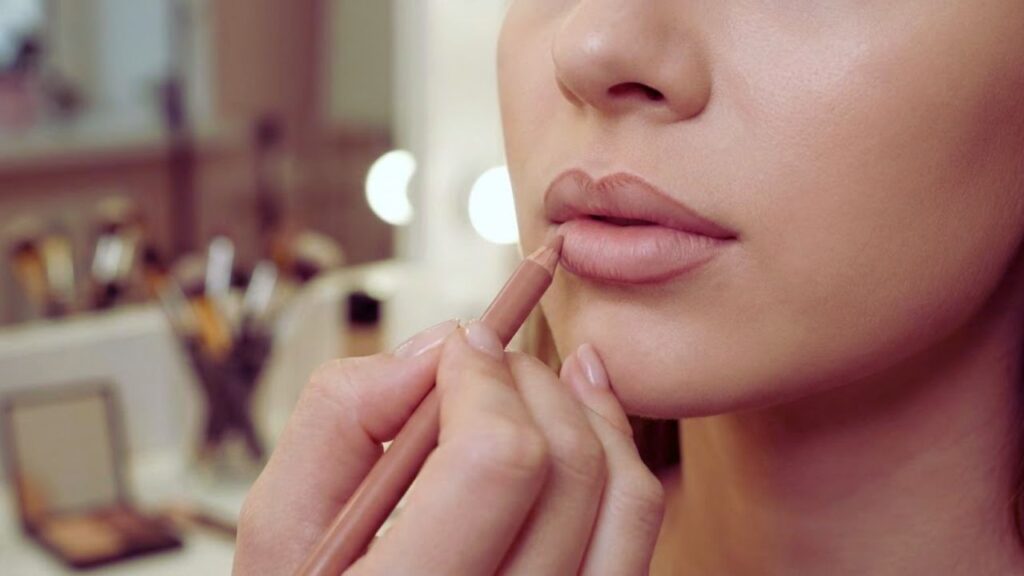
In a crowded café restroom, a young woman calmly applies her lip makeup, unaware of the quiet audience behind her. With just two light pencil strokes and a soft press of gloss, her lips change instantly. There is no heavy contouring or dramatic outline—only a natural fullness that suggests balance and ease. Her lips don’t announce makeup; they quietly reflect softness and vitality. Later, when you stand in front of your own mirror and try to recreate the look, something feels missing. You follow the same steps, use similar products, yet the result looks dull. The difference comes down to precise pencil placement—a small adjustment that completely changes the outcome.
It’s Not About Bigger Lips, It’s About Visual Direction
This technique isn’t designed to make lips larger. Instead, it focuses on guiding where the eye naturally looks. Traditional advice—lining around the lips and blending inward—can still work in theory, but in natural daylight it often feels unnatural. The outline can sit awkwardly against real skin texture, making lips appear disconnected from the face. Rather than enhancing, it can distract. The modern goal is subtle emphasis, not exaggerated borders.
Why Traditional Lip Lining Often Misses the Mark
Many people learned a simple formula: overline slightly, smudge, fill, and finish. However, this approach frequently fails under realistic lighting. On real faces, strong outlines rarely melt into the skin. The effect can appear artificial and obvious, especially during everyday moments like morning errands or casual conversations. What looks fine in mirrors or photos may feel off in real life.

A More Refined Way to Shape the Lips
Professional makeup artists now focus less on creating false volume and more on strategic attention placement. The fuller appearance comes as a side effect, not the goal itself. Lips appear balanced in photos, video calls, and face-to-face interactions because light is drawn to specific areas—not because the entire lip line is heavily traced.
Why Tiny Adjustments Make the Biggest Difference
The effectiveness of this method comes from small, deliberate pencil movements. Rather than adding size, it enhances what already exists. When you look closely, the most convincing results stay within the natural lip shape. These micro-adjustments feel believable, creating softness instead of bold definition.
Where Makeup Artists Actually Place Lip Liner
If you pay attention, you’ll notice professionals avoid outlining everything. Instead, they concentrate pigment on:
- The peaks of the Cupid’s bow
- The center of the lower lip
- The rounded areas just off-center
The outer corners are barely touched. This creates an effect that feels suggested rather than drawn, giving shape without harsh lines.
Why the Result Looks Effortlessly Natural
A London-based makeup artist explains that she uses the same lip pencil for every client, changing only the placement. Many assume cosmetic fillers are involved, but the real impact comes from soft edges and intentional highlights. Clients often say they look well-rested rather than heavily made up. That quiet freshness is what makes the look so convincing.

How the Brain Reads Lip Shape
This approach works because the eye naturally follows contrast, curves, and reflected light. We instinctively focus on areas such as:
- The dip of the Cupid’s bow
- The curve at the center of the lower lip
- Glossy points that catch light
Enhancing these zones creates the impression of fullness without relying on strong outlines.
Soft Fullness: Step-by-Step Application
Start with clean, dry lips and a relaxed expression. Using a sharpened nude pencil close to your natural lip tone:
- Draw a short, smooth bridge across the Cupid’s bow, connecting the peaks just above the dip.
- On the lower lip, place the pencil about one millimeter outside the center and sketch a small arc aligned with the width of your iris.
- Leave the outer thirds mostly untouched.
- Lightly connect the center markings toward the corners using faint upward strokes that fade out.
- Soften with a fingertip and apply gloss only at the center.
The result is plump, balanced lips that feel natural and understated. Restraint is essential—too much liner near the edges breaks the illusion. Always step back and build slowly.

Why This Method Lasts and Looks Good Anywhere
Beyond aesthetics, this technique is practical. It remains forgiving even when applied quickly or with an unsteady hand. It adapts well to different lighting conditions and works even when skin texture isn’t perfect. Unlike rigid outlines, this approach moves naturally with your expressions, making it ideal for everyday wear.
Key Principles Behind the Technique
- Central focus: Liner placed mainly on the Cupid’s bow and lower lip center creates instant volume without harsh contours.
- Softened corners: Minimal or no liner at the mouth corners keeps the look balanced and natural in daylight.
- Targeted shine: Gloss or balm applied only at the center enhances dimension in both photos and real life.
